Aviad Hai
Department of Biomedical Engineering
Assistant Professor
(608) 890-3411
2112 Engineering Centers Building
1550 Engineering Dr
Madison, WI 53706
Education
B.Sc. 2002 Computer Science and Biology, Hebrew University of Jerusalem; M.Sc. 2006 Neurobiology, Hebrew University of Jerusalem; Ph.D. 2011 Neuroscience and Electrical Engineering, Hebrew University of Jerusalem; Postdoctoral Fellow 2011-2013 Biological Engineering, Massachusetts Institute of Technology; Postdoctoral Associate, 2014-2018 Biological Engineering, Massachusetts Institute of Technology
Research Areas
- Biotechnology
- Neuroscience
- Spectroscopy Microscopy Imaging
Bioelectronic sensors for non-destructive electrophysiology
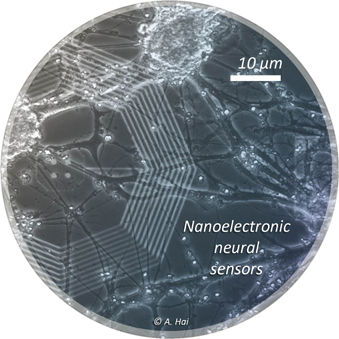
We develop novel nanofabricated electromagnetic sensors for minimally invasive recording of brain activity. Our rationale revolves around engineering scalable devices that are versatile enough to record from many locations and generate readouts of a multitude of neural signals. We work on fabricating devices that maintain a stable and strong electrical interface with neurons, achieving high signal recordings without inflicting damage to nerve tissue.
We use our technologies to address questions of the dynamics of nerve cell injury and repair, and for studying neuronal network activity in relation to learning, information storage, neuropharmacology and the study of neuropathological processes both in vitro and in vivo. We analyze the cell-biological processes occurring at the cell-device interface and explore cytoskeleton-substrate interactions using electrophysiology, optical imaging, electron microscopy and computer simulations.
Injectable probes for whole-brain recording
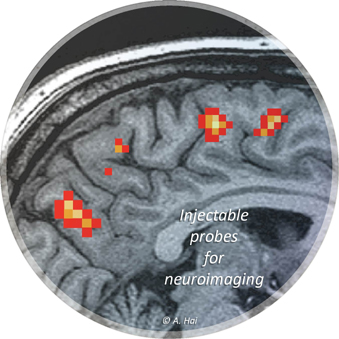
We develop electronic and molecular sensors for in vivo imaging, and for measuring neural activity across large volumes of the brain. Using novel approaches for functional Magnetic Resonance Imaging (fMRI) and magnetometry, we seek to develop a toolbox that combines molecular and electrophysiological specificity with minimal invasiveness in animal models in vivo.
We develop injectable and implantable sensors able to transduce biochemical and biophysical components of neural activity to magnetic-field perturbations that can be detected remotely. We actively collaborate to develop effective techniques for encapsulation and delivery of the sensors.
Chemically-functionalized array devices for parallel sensing of neurotransmitters and electrophysiology
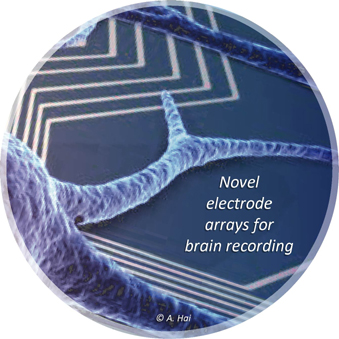
We use chemical functionalization of sensor arrays to obtain molecular specificity for multiplexed sensing of both electrical and chemical neural events in parallel. By interfacing biologically active molecules with on-chip electronic transducers, we generate reliable systems that translate specific molecular events into electrical signals proportional to the concentration of neuropharmacological analytes.
Examples include functionalization of the gate surface of ion-sensitive field effect transistors (ISFETs) with neurobiologically-active enzymes and receptors for the detection of neurotransmitters in the brain. We are interested in employing the high specificity of enzymes, receptors and antibodies for the assembly of reaction-specific neurobiological sensor systems that can be used for a wide range of applications.