
Karthik Anantharaman
Department of Bacteriology
Associate Professor
4545 Microbial Sciences Building
1550 Linden Drive
Madison, WI, USA - 53706
Education
B.Tech, National Institute of Technology, Karnataka India; PhD, University of Michigan; Postdoctoral, University of California Berkeley
Research Areas
- Biotechnology
- Computational Biology and AI
- Microbial Biophysics & Virology
- Synthetic & Systems Biology
Computational Biology and AI Approaches for Microbial/Viral Ecology, Evolution, and Biotechnology
Transforming Microbial Ecology and Bioengineering with Foundation Genome Language Models
Our research program occupies a unique global position as one of the only research groups systematically bridging foundation AI models, microbial and viral ecology, and bioengineering to decode and redesign the metabolic logic of viruses and microbiomes. We address fundamental challenges in modern biology involving how viruses, the most abundant biological entities on Earth, reshape metabolism and microbiomes. Towards this, our program is not only decoding the virosphere, but actively building the computational infrastructure, tools, and frameworks that will define the next era of microbiome science and viral biotechnology.
Foundation Genome Language Models for Microbial and Viral Genomics
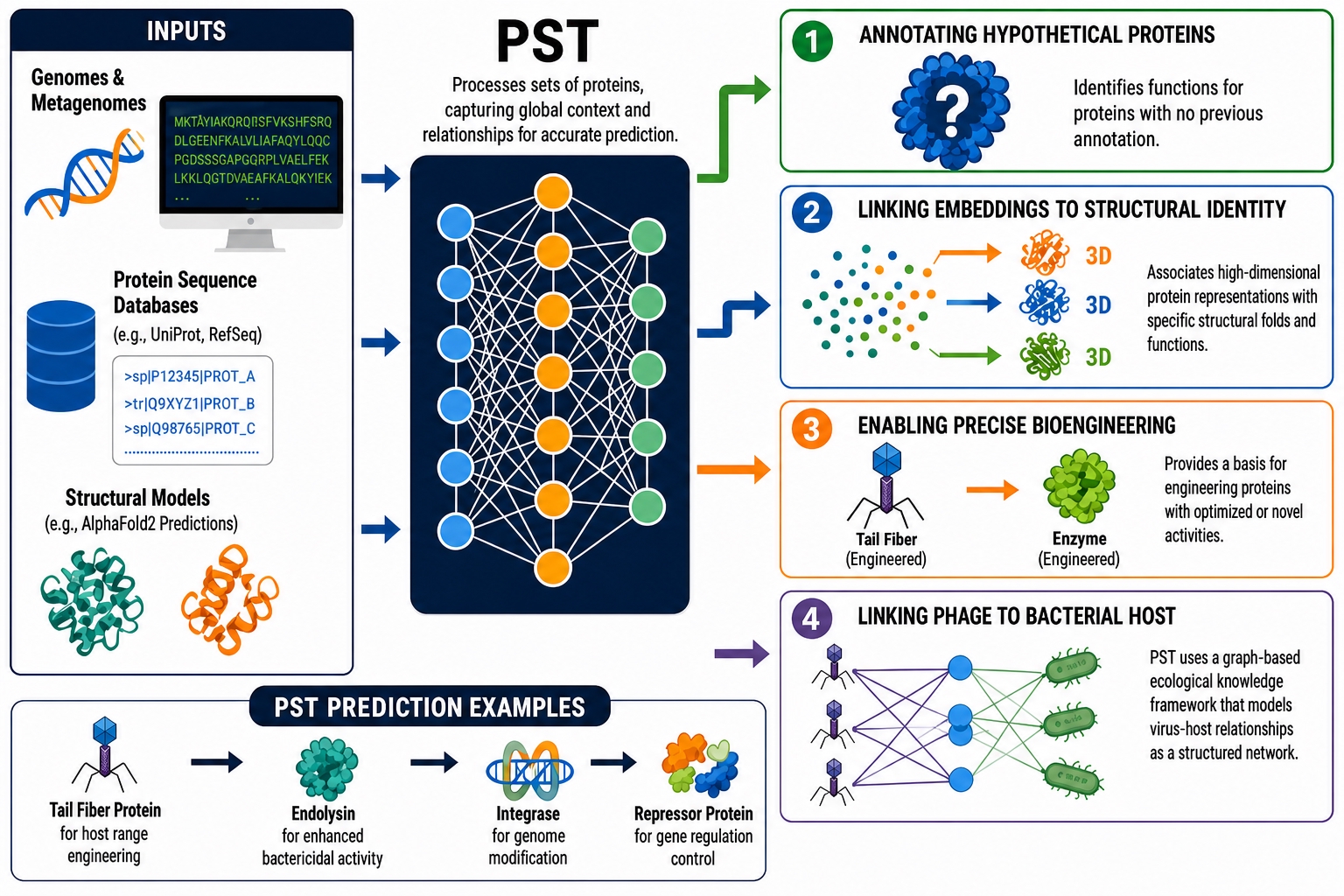
Central to this vision is Protein Set Transformer (PST), a foundation model developed by us that learns the organizational grammar of entire genomes, not just individual genes, enabling transformative new predictions about viral and microbial function. Its flexible, genome-agnostic architecture enables protein- and genome-level applications and generalizes powerfully across bioinformatics tasks through transfer learning. PST represents a paradigm shift in viral genomics: it encodes fundamental principles of genome functional organization into learned representations, capturing how viruses deploy metabolic strategies within highly constrained genomic spaces. By extending PST’s foundations, we are building a platform that directly contextualizes virus-microbe-metabolite relationships at an unprecedented scale.
Metabolic Reprogramming: Decoding Viral Impacts on Host Function
Our laboratory has maintained a long-term focus on advancing knowledge of viral impacts on microbial metabolism. We have pioneered the discovery and characterization of viral genes that manipulate metabolic transformations, demonstrating that viruses function as active metabolic engineers operating at the heart of microbial communities. This work has been published in high-impact journals including Nature Microbiology, and Science, and has generated significant impact, establishing foundational frameworks now used across the global research community.
AI for Bioengineering
Critically, the principles encoded within PST extend far beyond discovery science. By learning the deep organizational rules that govern how genomes encode, deploy, and coordinate metabolic functions, PST creates a rigorous computational foundation for bioengineering microbes and phages with precision. We are leveraging PST-derived frameworks to extract generalizable design rules from the vast natural diversity of viral and microbial genomes, rules that dictate how metabolic content, genome organization, and virus-host compatibility co-evolve. These rules directly inform the rational engineering of phages for phage therapy, enabling target-specific pathogen elimination while preserving beneficial microbiome members, and the deliberate remodeling of microbial communities through microbiome engineering. Overall, our program is positioned to lead the next generation of microbiome-informed biotechnology from precision phage therapies to the deliberate design of microbial communities for human health, agriculture, and environmental resilience.