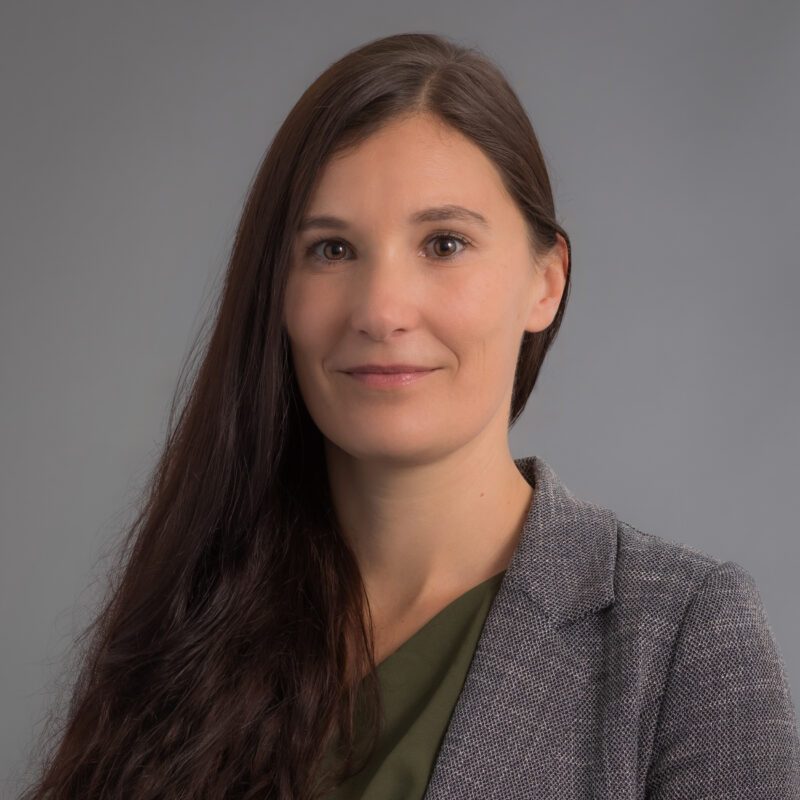
Sarah Loerch
Department of Anesthesiology
Assistant Professor
5407 WIMR II
1111 Highland Ave
Madison WI 53705
Education
BS., ETH Zurich;
MS., ETH Zurich (Dario Neri);
Eidg. Dipl. Diplom Apothekerin (PharmD equivalent),
Switzerland;
MS., University of Rochester;
PhD., University of Rochester (Clara Kielkopf)
Research Areas
- Computational Biology and AI
- Neuroscience
- RNA/DNA Biophysics
- Structural Biology
Translational control in neurological disease

Structural and biophysical mechanisms of translational regulation
The Loerch lab studies how cells regulate ribosomes to control protein synthesis in space and time. We are particularly interested in neurons, where translation must respond rapidly to signaling while also being coordinated across highly specialized cellular compartments. Our goal is to understand how signaling pathways and translation factors generate distinct ribosome states, how those states are distributed within cells, and how they contribute to neuronal function and disease.
We combine cryogenic electron microscopy, protein biochemistry, biophysics, neuronal cell biology, and computational analysis. Our work ranges from mechanistic studies of purified proteins and translation complexes to the identification of individual ribosomes directly inside neurons.
Molecular mechanisms of translational control
Ribosomes move through many functional states as they decode messenger RNA, interact with translation factors, pause, collide, or enter regulated inactive states. The distribution of these states can change rapidly in response to cellular signaling.
We use single-particle cryo-EM, biochemical reconstitution, enzymology, and other biophysical approaches to determine how translation factors and signaling pathways reshape the translation cycle. A major focus is eukaryotic elongation factor 2 kinase, or eEF2K, which regulates translation elongation by phosphorylating eEF2. We investigate how eEF2K is activated, how it recognizes its substrates, and how changes in elongation produce broader changes in ribosome activity.
These studies connect the biochemical and structural properties of individual proteins with the behavior of the translation machinery as a whole. They also provide a mechanistic foundation for understanding how neurons adjust protein synthesis during signaling, stress, and disease.
Ribosome states and localized translation in neurons
Neurons face an unusual problem of scale. Proteins may be needed far from the cell body, within axons or dendrites, where transporting every finished protein would be slow and inefficient. Local translation allows neurons to produce proteins near the sites where they are required.
We study how ribosome states differ between neuronal cell bodies and processes and how they are remodeled by extracellular signals. Our experimental systems include primary sensory neurons and human induced pluripotent stem cell-derived neuronal models. We are particularly interested in mechanisms relevant to neuronal plasticity, pain, and neurodevelopmental disease.
By combining cellular perturbations with structural and biochemical measurements, we aim to determine how signaling pathways alter translation at specific locations within the neuron and why particular ribosome states accumulate in different cellular environments.
Structural biology inside cells
Purified complexes reveal molecular mechanisms at high resolution, but they do not show where those complexes function in the cell. We therefore use cryogenic fluorescence microscopy, cellular cryo-EM, and two-dimensional template matching to identify individual ribosomes directly inside frozen neurons.
These approaches allow us to ask which ribosome states occur in different cellular compartments, how their populations change following stimulation, and whether specific states are enriched near organelles or other cellular structures. They are especially valuable in thin neuronal processes, where ribosomes are sparse and difficult to analyze using conventional averaging methods.
Making sense of the ribosome structural landscape
The growing number of ribosome structures presents both an opportunity and a challenge. Structures are often described using different nomenclature, reference frames, and classification schemes, making it difficult to compare results across organisms and experiments.
The RiboState Atlas is one way we are addressing this problem. We are developing computational approaches to standardize ribosome structures, extract comparable biophysical features, and place newly observed states within the broader conformational landscape of the ribosome. This framework helps us interpret our biochemical and cellular data while identifying recurring states and unanswered questions across the field.
Graduate students in the Loerch lab can pursue projects in cryo-EM, protein biochemistry, enzymology, structural biophysics, neuronal cell biology, image analysis, or computational structural biology. Projects connect molecular mechanism with the spatial and cellular regulation of translation.